But not just a light meter. A plant library, a 3D room scanner, and a year-round predictive daylight generator, so you can see exactly where houseplants will thrive at any point in your space and at any time of year. Free for iPhone.
Scan a room and map its daylight across the whole floor
See which plants will thrive in each specific spot
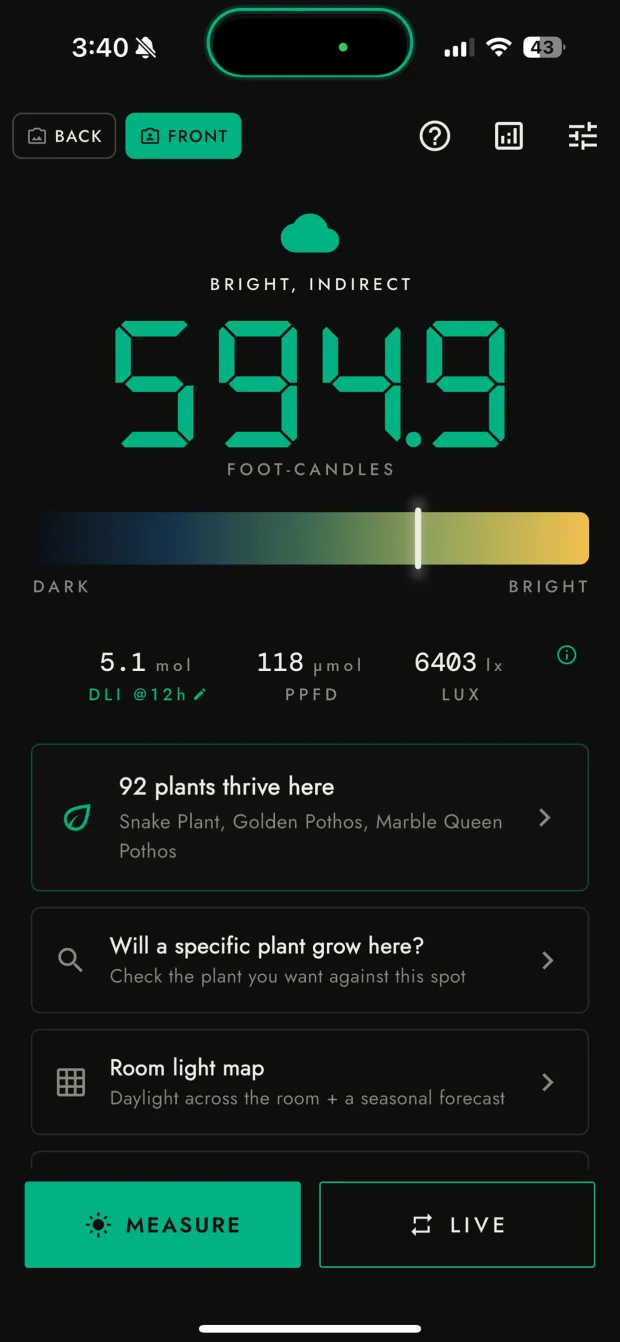
Real readings: foot-candles, PPFD and DLI from your camera
Aim your iPhone at any spot and read the light straight from the camera's exposure data: foot-candles, PPFD, and DLI, with no extra hardware. Each iPhone model is calibrated against a reference meter, so a reading means the same on any phone. The numbers are estimates for comparing one spot to another, not lab-grade measurements, and the app says so plainly.
The Plant Library
Which plants thrive here?
Measure a spot and the app ranks your whole plant library by how well each one suits the light there, marking what's ideal and saying plainly when a plant won't be happy, with what would do better instead. Check a plant you have in mind, or browse everything that fits.
The Room Scan
Map the whole room, not one spot.
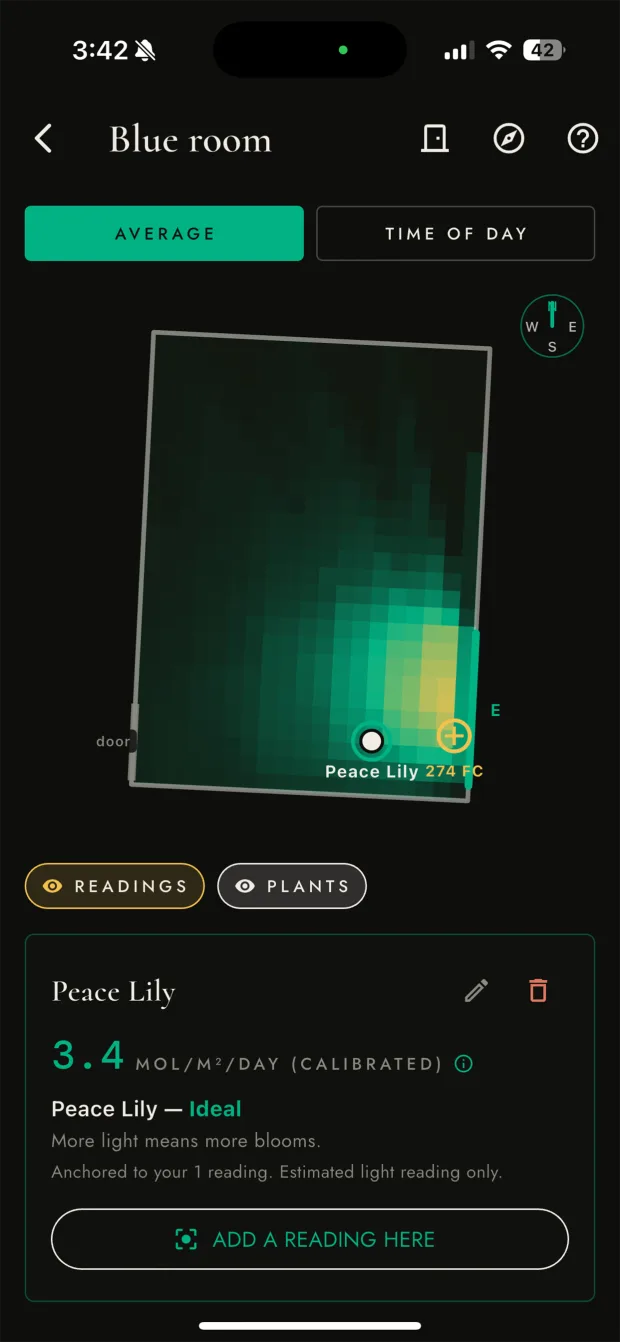
Scan a room with LiDAR, or just tap the floor corners in AR on any iPhone, and the app models daylight across the entire floor: through your real windows, at your real latitude, facing the direction the room actually faces. Take a reading anywhere on the map and it anchors to that measurement, so the whole floor is calibrated from the spots you checked yourself. Switch between an averaged view and time of day to watch the bright zone travel across the room through the afternoon.
The Seasonal Forecast
Place for the year, not for today.
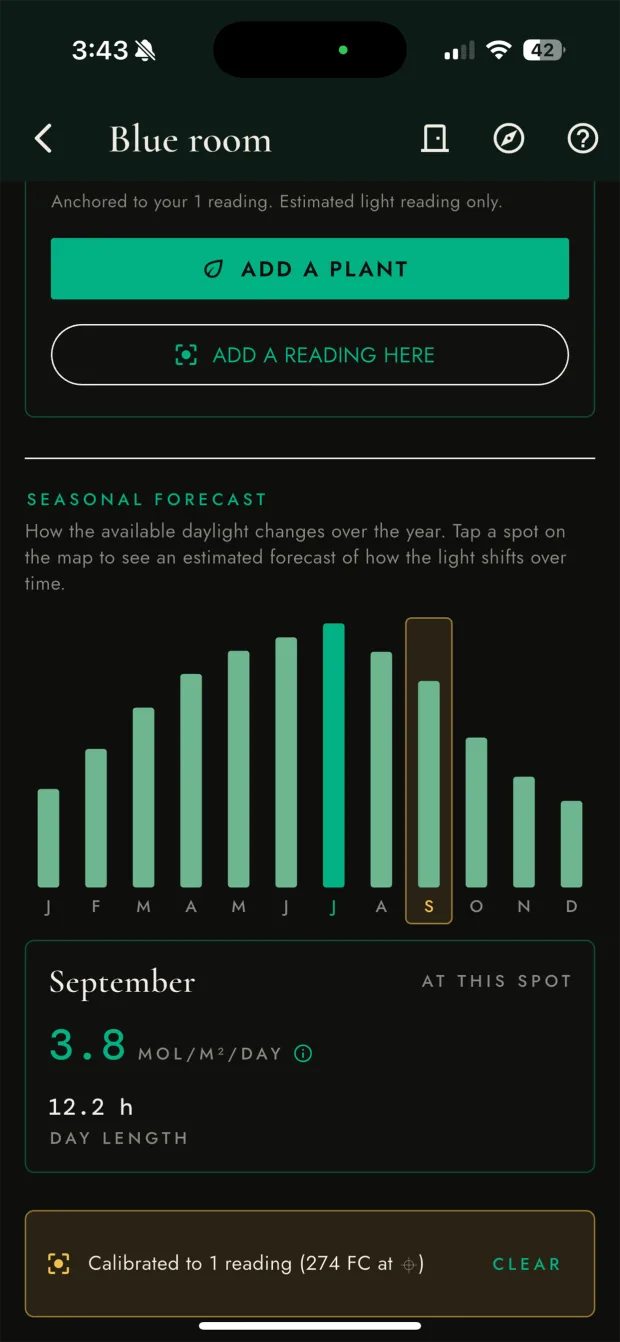
Every spot on the map carries a month-by-month forecast of its daily light integral, so you can spot the windowsill that carries a fig through July and starves it by November. Drop plants onto the map and check them against the whole year before you decide where anything lives.
Questions
Light & plants, explained.
How much light do my houseplants need?
It depends on the plant, but as a rough guide: low-light plants get by around 50–250 foot-candles, most houseplants are happiest from roughly 250–1,000 fc, and high-light plants want 1,000+ fc. What matters more than any single reading is the daily light integral (DLI), the total light a spot receives over a day. The app measures both, so you can match a plant to a spot precisely.
What's the difference between lux, foot-candles, PPFD, and DLI?
Lux and foot-candles measure brightness as the human eye sees it (foot-candles ≈ lux ÷ 10). PPFD measures the light plants actually use for photosynthesis, in µmol/m²/s. DLI adds that usable light up over a whole day, in mol/m²/day, the number that best predicts whether a plant will thrive. The Plant Light Meter reports foot-candles, PPFD, and DLI together.
How do I measure how much light a spot in my home gets?
Simply point your phone out towards the light at the intended spot. The app then gives you plant recommendations based on your reading. For a fuller picture, the app can scan the room to map daylight across the whole floor, hour by hour or month by month, and even predict how much average light you will collect in a spot over a whole year.
How accurate is measuring plant light with an iPhone camera?
iPhone settings have been calibrated in the app, and for most situations our measurements are within 5–15% of a spectrometer reading.
Which plants will actually grow in my specific room?
Simply measure the light and the app will show you a list of plants that can (or can't) work in your space, sorted by best fit first.
What is DLI, and why does it matter more than a single reading?
DLI (daily light integral) is the total amount of usable light a spot receives over a full day, in mol/m²/day. A single reading only tells you the light right now; DLI captures the whole day, which is what plants actually respond to. The app estimates DLI from your reading and your location, and forecasts it month by month.
Do I need a LiDAR iPhone to map a room's light?
No. LiDAR makes the room scan faster on Pro models, but it isn't required. On any recent iPhone you tap the floor corners in AR and the app builds the same daylight map.
Does the app account for how light changes through the seasons?
Yes. Using your location, it forecasts DLI month by month for any spot, so you can place a plant for how the light will be in winter, not just how it is today. You can even see how daylight will fall across your room hour by hour or month by month.
Is the Plant Light Meter available on Android?
Not right now; it's iPhone only. Accurate readings depend on calibrating the app to the phone's camera, and iPhone uses a small, consistent set of cameras we can calibrate each model against a reference meter. Android spans hundreds of devices with very different cameras, which makes reliable calibration far harder. It's something we may revisit.
Is the Plant Light Meter free?
Yes, it's free on the App Store, with no account, no ads, and no advertising identifiers. Explaining to customers how light works in a given space has been a difficult endeavor in our experience working in the horticulture industry, and we hope that with this app people will have an easier time understanding the concept.